

From heavy rain to a record-dry July
Cape Town’s (and the greater southwestern Cape’s) rainfall story in 2026 has been one of sharp contrasts. The year began with several significant rainfall events in February, April, May and early June, bringing much-needed water to parts of the Western Cape but also causing flooding and damage. Then, almost as abruptly, the rain disappeared. At the end of July, parts of the southwestern Cape had experienced some of their lowest rainfall totals on record for the usually high rainfall winter rainfall month – this was followed by very low August rainfall.
For a city that came within sight of “Day Zero” during the 2015-2018 drought, unusually dry winter months inevitably raises the question. Is Cape Town heading towards another water crisis?
The short answer is: not yet. But the events of 2026 are an important reminder of just how quickly rainfall and water availability conditions can change – and why Cape Town’s long-term water security can no longer depend on rainfall-fed dams alone.
A wet start to 2026
The 2026 rain year initially got off to a surprisingly wet start. Several severe weather systems affected the Western Cape during February, April, May and early June, delivering significant rainfall across parts of the province.
In February, a cut-off low-pressure system brought more than 80-100 millimetres (mm) of rain to parts of the Overberg, causing localised flooding as well as road closures, electrical outages and damage to water infrastructure. A Level 4 thunderstorm warning was issued by the South African Weather Service (SAWS). At a private residential rain gauge in Stanford, February recorded the highest monthly rainfall other than the three winter months (June-July-August) since records began there in 1987 – 167 mm (thanks to 93 mm of rainfall on the 10th February and 131 mm from the 9-11th February), approximately nine times the long-term February average.
April, May and early June brought another sequence of major rainfall events. In some areas, monthly rainfall totals were several times higher than long-term averages, accompanied by severe flooding, uprooted trees, electrical outages and infrastructure damage following another cut-off low-pressure system from the 11-13th May (with rainfall totals exceeding 500 mm in the Breede River valley). An Umvoto-monitored weather station in the Hemel-en-Aarde Valley recorded its second-highest monthly rainfall total since monitoring began in 2003 – 207 mm (thanks to 164 mm of rainfall from the 10-12th May), approximately three times its long-term average. The intense rainfall also caused severe flooding, power outages and road damage to areas along the coast from George to Gqeberha.
These events provided an important boost to water storage in various supply dams (including the Western Cape Water Supply System [WCWSS], where the total storage volume increased by ~20% in a single week following the May storm system) heading into winter. But the wet start to the year did not last.
Then July changed the picture
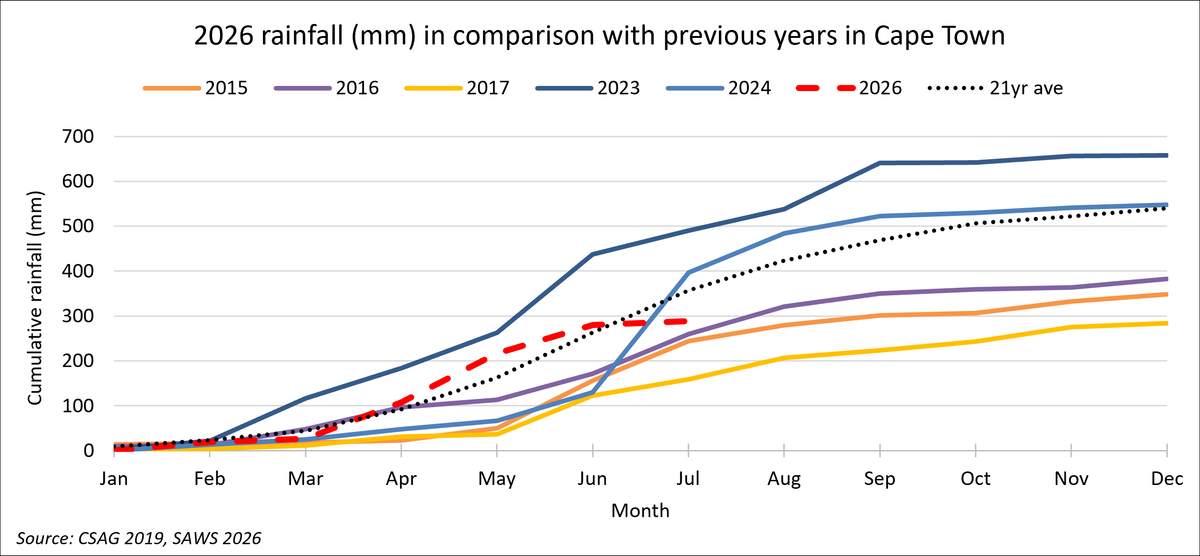
July 2026 was exceptionally dry across much of the southwestern Cape. Preliminary SAWS data showed that Cape Town International Airport (CTIA) received just 14 mm of rain during July (see graph below) – its lowest July rainfall since records began in 1958 and only around 16% of its long-term July average. The previous record low was 18 mm in 1987. Similarly, the Observatory weather station recorded its driest July since records began in 1850.
The immediate cause was an intense blocking high-pressure system over the Atlantic Ocean (the St Helena or South Atlantic High Pressure [SAHP]), west of South Africa. The system effectively pushed the normal winter cold fronts further south, significantly reducing the number reaching the Western Cape. According to SAWS, only three weak cold fronts crossed the southwestern Cape during July. And with a changing climate, the strength of the SAHP systems could potentially increase causing further expansion thereof and a shift further southward thereby blocking frontal systems during winter.
That matters because the southwestern Cape is a winter rainfall region. June, July and August are normally critical months for replenishing surface water storage dams and other water resources before the long, dry summer.
Seasonal forecasts add another layer of uncertainty. SAWS expects El Niño conditions to strengthen as 2026 progresses, increasing the likelihood of warmer-than-normal conditions over the Western Cape during summer. Importantly, this does not mean that El Niño caused Cape Town’s dry July – the immediate July conditions were associated with the blocking SAHP system. Rather, a strengthening El Niño becomes relevant to the climate outlook as South Africa moves towards spring and summer.
So, is another “Day Zero” on the horizon?
Not at present.
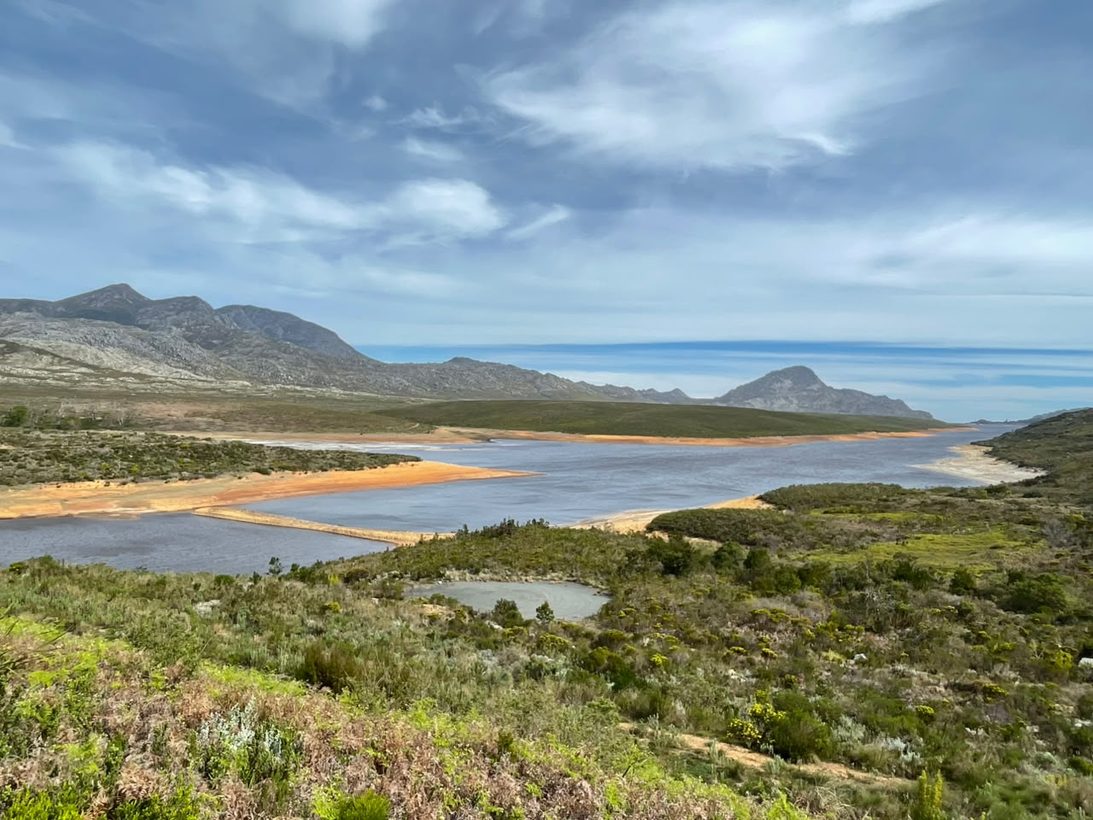
Despite the exceptionally dry July, Cape Town entered winter with the benefit of the heavy rainfall earlier in the year. On 24 August 2026, the major WCWSS dams supplying the City were collectively at ~77% of capacity. That is substantially below the 92% recorded at the same time in 2025, but it does not represent an immediate “Day Zero” scenario.
The City’s latest Water Outlook similarly indicates that Cape Town’s current water supply remains stable. However, it also notes that the risk of future restrictions has increased compared with recent years, particularly if rainfall remains below expectations while water demand continues to grow.
The long-term rainfall record at CTIA (graph above) illustrates why the recent dry conditions are nevertheless worth watching. If the current low-rainfall pattern persists through the remainder of the rainfall season (i.e., the tail end spring rainfall months of September and October, with August also showing very below average rainfall), 2026 could begin to resemble some of the lower-rainfall years experienced during the 2015-2018 drought.
Rainfall at CTIA should, however, be viewed as one indicator rather than a direct measure of Cape Town’s overall water security. The rainfall stations in Steenbras, Wemmershoek, Berg River and Theewaterskloof Dam catchments need to be included as that is where significant rainfall occurs that feeds into the WCWSS; and the CTIA (and Cape Flats) station lies in a rain shadow receiving less rain than the mountain catchments. Furthermore, the WCWSS draws on a much larger network of mountain catchments, dams and infrastructure, and water availability is influenced by rainfall distribution, catchment runoff, evaporation, demand, and water-resource management.
In other words, “Day Zero” is not triggered by one dry month. The 2015-2018 crisis developed through a multi-year drought combined with high dependence on rainfall-fed surface water and pressure from a growing city. That distinction is important.
What does climate change have to do with it?
It is tempting to look at a month like July 2026 and label it “climate change”, but weather and climate are not the same thing. Individual storms, floods or dry months occur naturally. Climate change alters the background conditions in which those events occur – changing temperatures, rainfall patterns, evaporation, and the likelihood or severity of certain extremes over time. The increase in the frequency of these severe weather events, whether major drought or flood events, is what is important to understand, and this is what is predicted to occur as a result of climate change going forward. For the Western Cape, rainfall is expected to occur in more extreme events instead of extended rainfall periods, with longer dry periods in between each.
For Cape Town, the long-term concern is not simply that every year will be drier. It is that water managers increasingly have to plan for greater uncertainty: intense rainfall and flooding can be followed by extended dry periods, while higher temperatures can increase evaporation and water demand. Cape Town’s own climate planning anticipates a hotter future, declining average rainfall and continued drought risk. This makes relying on historical rainfall patterns alone increasingly difficult when planning the city’s future water supply. And the challenge is also not rainfall alone.
Water security reflects the balance between the amount of water available, how reliably it can be supplied, and how much water a growing population and economy require. Climate variability places pressure on the supply side of that equation, while urban growth and increasing consumption add pressure on the demand side. That is why Cape Town’s response needs to extend beyond waiting for dams to fill.
Building resilience beyond the dams
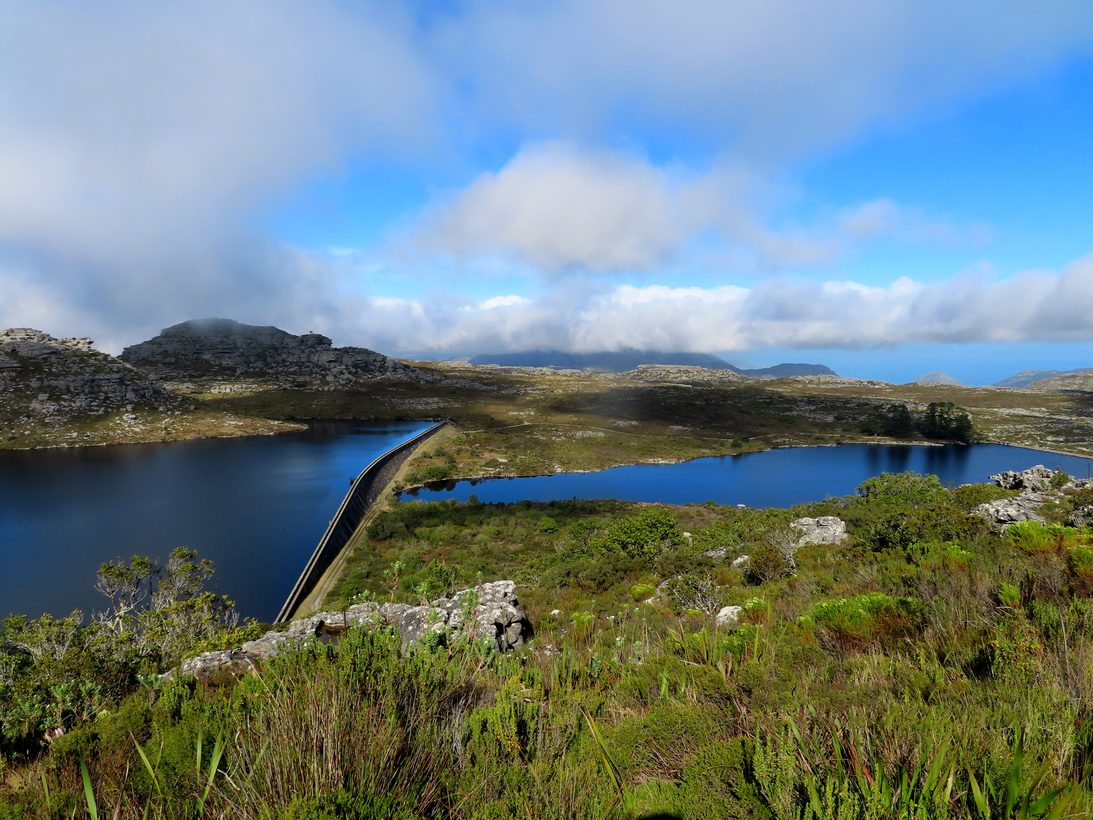
One of the most important lessons from the “Day Zero” drought was the need to diversify Cape Town’s water sources. Water resource specialists refer to the coordinated use of different sources as “conjunctive water use”. Instead of relying predominantly on surface water dams, a more resilient system combines surface water with groundwater, water reuse, desalination, and other interventions (including water conservation and water demand management [WC/WDM], e.g., leak repairs and pressure management), using each source strategically according to prevailing conditions. This principle sits at the heart of the City of Cape Town’s New Water Programme.
Groundwater is an important part of that mix. Umvoto continues to work with the City of Cape Town and City of Cape Town-appointed engineers on groundwater components of the programme, including the Cape Flats Aquifer, Atlantis Aquifer, and Table Mountain Group Aquifer systems.
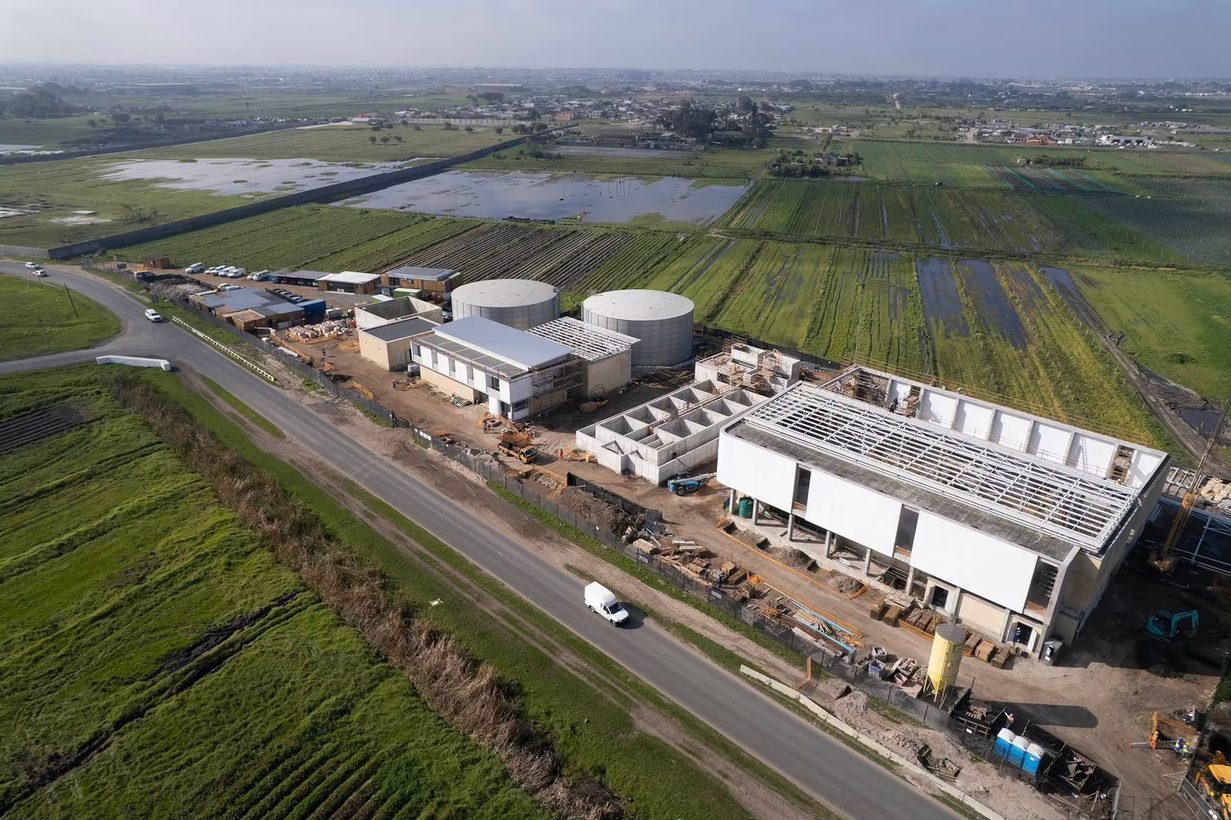
On the Cape Flats, Managed Aquifer Recharge (MAR) provides an additional tool for managing water underground. Rather than viewing an aquifer simply as a source from which groundwater is pumped, MAR allows water to be deliberately recharged into the aquifer as part of a managed system, helping to protect groundwater resources and improve the long-term resilience of the supply scheme.
The scale of investment reflects how central diversification has become part of Cape Town’s water strategy. For the 2026/27 financial year, the City allocated R570 million to the New Water Programme, including R297 million towards Cape Flats MAR, alongside investment in groundwater extraction, Atlantis Aquifer infrastructure, desalination planning, and further Table Mountain Group Aquifer drilling.
The City’s latest Water Outlook envisages the wider programme ultimately providing peak additional capacity of approximately 300 million litres of water per day by 2036, through a combination of groundwater, surface water augmentation, water reuse, desalination, WC/WDM, and nature-based solutions.
A warning, rather than a crisis
So, is Cape Town heading towards another “Day Zero”?
The current data do not suggest an imminent repeat of 2018. Dam storage remains relatively healthy and the City currently assesses the immediate risk to supply as low. But the dry July and August of 2026 is still a warning worth paying attention to. Within a matter of weeks, the Western Cape moved from flooding and exceptionally high rainfall to record-breaking dryness in parts of the region. That volatility illustrates precisely why water security cannot be judged by whether it rained heavily last month – or even by how full the dams are today.
Cape Town’s long-term resilience will depend on using wet years to prepare for dry ones, managing demand carefully and continuing to develop a diversified water supply before the next prolonged drought arrives.
The lesson from “Day Zero” is not that Cape Town should panic every time the rain stops. It is that the best time to prepare for the next drought is before the dams are empty.

